


Is online therapy as effective as in-person? Here's what the research says
You've been thinking about therapy. Maybe for a while now.
But something holds you back. Perhaps it's the question so many people ask before they take the first step: "Can therapy through a screen really be as good as sitting in someone's office?"
It's a fair question, and an important one. You should make this decision with real evidence. So let's look at what the science actually says.
Is online therapy as effective? Yes, and the evidence is strong
In 2021, a team of researchers reviewed over 100 studies comparing live video therapy to in-person therapy. Their conclusion was clear: the outcomes were essentially the same. People who did therapy over video improved just as much as those who sat in a therapist's office, particularly for anxiety, depression, and PTSD, some of the most common reasons people seek help (Fernandez et al., 2021; effect size g = 0.99).
This wasn't a one-off finding. In 2020, a landmark trial published in JAMA Psychiatry, confirmed that internet-delivered cognitive behavioural therapy (CBT) was just as effective as face-to-face CBT for depression, while being more accessible and generating lower costs (Carlbring et al., 2018; Johansson et al., 2020). And in 2025, a large real-world study in The Lancet Psychiatry, suggested these results hold outside of controlled research settings too, in everyday clinical practice, with real patients and real therapists (Salokangas et al., 2025).
The pattern across decades of research is remarkably consistent: when therapy is delivered by a qualified professional over video, the outcomes are comparable to being in the room.
It's the relationship that matters
If you've ever wondered why therapy works, here's what decades of research tell us: the single most consistent predictor of whether therapy helps is the therapeutic alliance: the quality of trust, warmth, and collaboration between you and your therapist.
One of the largest analyses ever conducted on this topic reviewed over 300 studies involving more than 30,000 people. The finding was unambiguous: a strong therapeutic relationship is reliably linked to better outcomes, regardless of what type of therapy is used, who the therapist is, or where in the world the therapy takes place (Flückiger et al., 2018; r = .278).
And here's the part that matters most for anyone considering online therapy: the strength of the therapeutic alliance was virtually identical in internet-based therapy (r = .275). The screen doesn't weaken the connection. What matters is whether you feel genuinely heard, understood, and safe with the person on the other side.
What a major 2026 review tells us
In early 2026, World Psychiatry, one of the most respected journals in the field, published a comprehensive review of every major innovation in psychotherapy over recent years. The authors, led by Professor Pim Cuijpers, examined digital delivery, personalised treatment, new therapy models, and efforts to reach underserved communities (Cuijpers et al., 2026).
Their conclusions are worth knowing:
- Internet-based psychotherapy works, with a robust evidence base across depression, anxiety, PTSD, and more.
- Having a real therapist guiding the process makes a significant difference. Therapist-guided online therapy produces meaningfully better outcomes and much lower dropout rates than self-help apps or chatbots alone.
- Personalisation matters. Matching the right therapist to the right person, based on their needs, preferences, and background, improves results.
- There's no single magic solution. Progress comes from combining thoughtful, incremental improvements, rather than from one flashy technology.
In a world of mental health apps and AI chatbots, the evidence still points to the same core truth: real human connection, delivered by a trained professional, is what drives lasting change.
Online therapy isn't a compromise. It actually removes barriers
More than one billion people worldwide live with a mental health condition, according to the WHO's latest data. Yet only a fraction ever receive adequate care. The treatment gap reaches over 80% in many low- and middle-income countries, and remains around 50% even in wealthier nations (WHO, 2025).
The reasons aren't just about willingness. They're structural:
- Geography: Qualified therapists are concentrated in major cities. If you live outside one, or in a country with few trained professionals, finding the right support can feel impossible.
- Language and culture: Research consistently suggests that therapy adapted to your cultural context produces significantly better outcomes. One large review found that culturally adapted therapy led to nearly five times greater odds of improvement compared to unadapted approaches (Hall et al., 2016; *g* = 0.52). Yet most platforms offer therapists trained in a single cultural worldview.
- Stigma: In many communities, walking into a therapist's office is simply not an option. Online therapy lets you access support from a private, safe space, without anyone needing to know.
- Cost and flexibility: Between work schedules, caregiving responsibilities, and the time and money spent commuting to appointments, in-person therapy isn't always realistic.
For many people, online therapy makes is what makes therapy possible in the first place.
Want to see if online therapy could work for you? Book a free discovery call to talk it through with one of our clinicians.
But not all online therapy is the same
This is an important distinction. The research is clear about what works, and what doesn't:
- Self-guided apps and chatbots can be helpful as light-touch supplements, but they come with higher dropout rates and smaller improvements compared to working with a real therapist (Cuijpers et al., 2026).
- AI-powered conversational agents are still in early stages. The evidence for their clinical effectiveness is very, very limited.
- Live video therapy with a licensed professional is where the strongest evidence lies, producing outcomes comparable to in-person therapy, with the same capacity to build a genuine therapeutic relationship.
When choosing online therapy, the most important thing isn't the platform's design or its marketing. It's whether you'll be working with a real, qualified, licensed therapist who is the right fit for you.
What to look for in an online therapist
Based on what the evidence tells us, here's what actually matters when choosing:
- Clinical credentials: are they licensed and professionally registered? What is their training and supervised experience?
- Cultural understanding: do they understand your background, your values, the world you navigate? The research suggests this meaningfully impacts how effective therapy can be.
- Language: therapy in a language where you feel emotionally at home, where you can express what you really mean, makes a real difference in how deeply you can engage.
- The human connection: do you feel heard? Sometimes a brief introductory conversation can tell you more than any profile page ever could.
If you've been thinking about starting
The science is clear: therapy works. Online therapy works. And the most important factor is finding someone you trust.
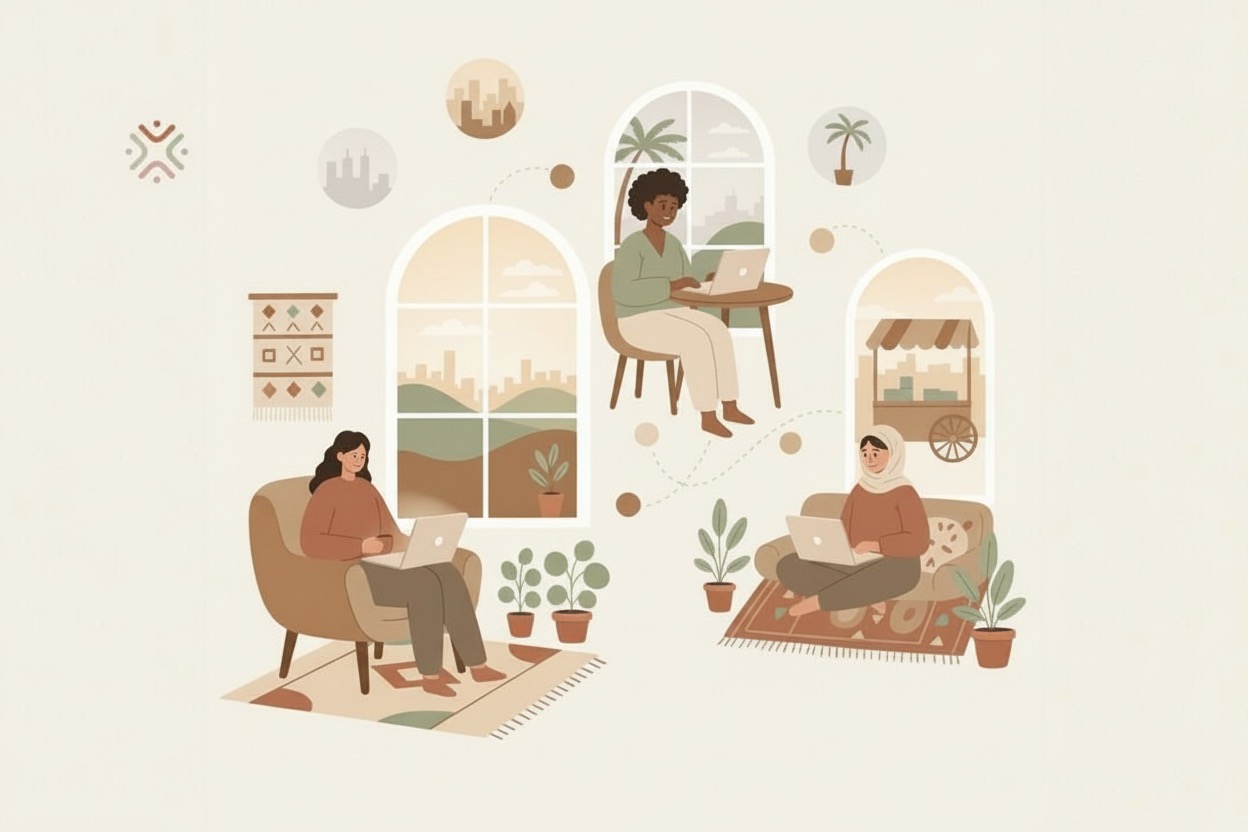
At Thera, every therapist is either a licensed or registered mental health professional, selected for clinical excellence and cultural awareness. We offer therapy in over 16 languages, across 28+ specialisations, with therapists from and for the Global South, MENA, BIPOC, and third-culture communities worldwide.
No subscriptions. No contracts. No algorithms deciding who you talk to. Just real humans.
If you're ready, we're here. Book a free discovery call here.
Not sure what a first session looks like? Here's what to expect and how to prepare.
And if you're not ready yet, that's also okay. Save this page. Come back when it feels right. Therapy works best when you decide it's time.
If you or someone you know is in crisis
Please reach out for immediate support:
International: Befrienders worldwide
USA: 988 Suicide & Crisis lifeline: call or text 988
UK: Samaritans: call 116 123
UAE: MOHAP Mental Health Helpline: 800 HOPE (4673)
Middle East & North Africa: Embrace lifeline
If you are in immediate danger, please call your local emergency services.
References
This article is for informational and educational purposes only. It does not constitute clinical advice, diagnosis, or treatment. Always consult a licensed mental health professional for personalised guidance.
David Greene
Licensed Psychologist
David Greene is a licensed clinical psychologist who provides evidence‑based psychotherapy for adults and adolescents experiencing anxiety, depression, trauma, and relationship difficulties. He combines rigorous clinical training with a warm, collaborative style to help clients build resilience.
Category
 Previous article